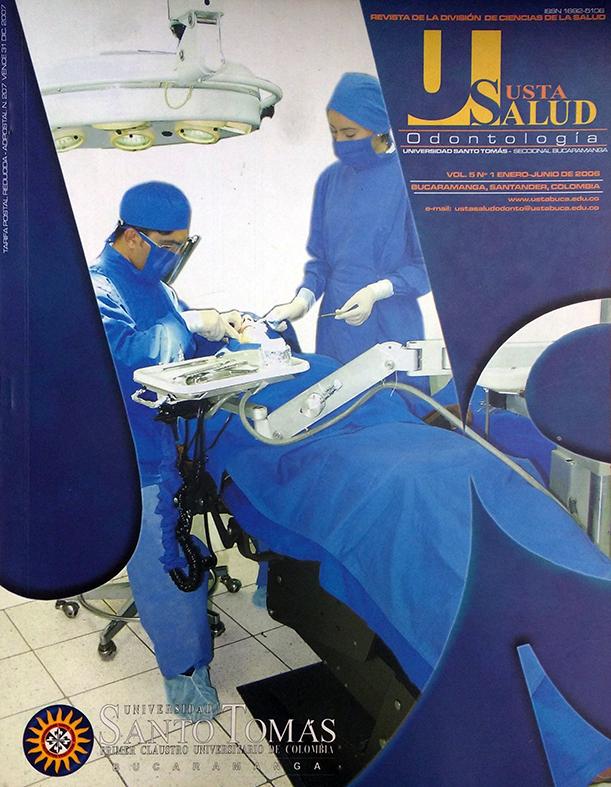
COMPARATIVE STUDY OF POSTEROANTERIOR CEPHALOMETRIC MEASURES OF PARENTS OF CHILDREN WITH LIP AND/OR CLEFT PALATE AND PARENTS OF CHILDREN WITHOUT OROFACIAL CLEFTING
DOI:
https://doi.org/10.15332/us.v5i1.1818Keywords:
Craniofacial morphology, Frontal cephalograms, Lip and/or cleft palateAbstract
Objective: To compare the posteroanterior cephalometric measures (PA) present in parents of children with cleft lip and/or palate and of parents of children without orofacial clefting (HOF).
Materials and methods: A descriptive cross-sectional and observational study was done. Eighty two parents were selected: fourteen-three parents of children with non-syndromic LPH and 39 parents of children without HOF. Sociodemographic variables and PA cephalometric measures were included. The statistical analysis plan implied the calculation of summary measures and T student and rank Wilcoxon test were applied. PA x-rays of the two groups were obtained using a standard technique. Photos were taken using a digital camera, which were then exported to a computer previously calibrated and they were analyzed using the Software Nemoceph.
Results: There were statistically significant differences between parents with and without orofacial fissures in the following variables: Cg-ENA, ENA-Me, Cg-Me, Ag-GA. Equally, there was statistical significance for gender in the presence of children with or without HOF in the variable Cg-ENA, ENA-Me, Cg-Me, Ag-GA, Bc-Me.
Conclusions: Some PA cephalometric cranio-facial measures can be different between population with and without LPH, its importance in the development of the HOF will allow the evaluation of the risk of the presence of this anomaly in future generations.
Downloads
References
Murray JC. Gene/environment causes of cleft lip and/or palate. Clin Genet 2002; 61: 248 – 256.
Mossey PA, Arngrimsson R, McColl J, Vintiner GM, Connor JM. Prediction of liability to orofacial clefting using genetic and craniofacial data from parents. J Med Genet 1998; 35: 371 – 378.
Rice R, Spencer-Dene B, Connor EC, Gritli-Linde A, McMahon AP, Dickson C, Thesleff I, Rice DP. Disruption of Fgf10/Fgfr2b-coordinated epithelial mesenchymal interactions causes cleft palate. J Clin Invest 2004; 113: 1692 - 1700.
Vanderas AP. Incidence of cleft lip, cleft palate and cleft lip and palate among races: a review. Cleft Palate J 1987; 24: 216 - 225.
Murray JC, Daack-Hirsch S, Buetow KH, Munger R, Espina L, Paglinawan N, Villanueva E, Rary J, Magee K, Magee W. Clinical and epidemiologic studies of cleft lip and palate in the Philippines. Cleft Palate Craniofac J 1997; 34: 7 - 10.
Cobourne MT. The complex genetics of cleft lip and palate. Eur J Orthod 2004; 26: 7 - 16.
Yoon YJ, Perdiomaki MR, Tallents RH, Barillas I, Herrera-Guido R, Fong CT, Kyrkanides S. Transverse craniofacial features and their genetic predisposition in families with nonsyndromic unilateral cleft lip and palate. Cleft Palate Craniofac J 2004; 41: 256 - 261.
Raghavan R, Sidhu SS, Kharbanda OP. Craniofacial pattern of parents of children having cleft lip and/or cleft palate anomaly. Angle Orthod 1994; 64: 137 - 144.
Kerrigan JJ, Mansell JP, Sengupta A, Brown N, Sandy JR. Palatogenesis and potential mechanisms for clefting. J R Coll Surg Edinb 2000; 45: 351 - 358.
Zeiger JS, Beaty TH, Liang K-Y. Oral clefts, maternal smoking, and TGFA: A meta-analysis of gene-environment interaction. Cleft Palate Craniofac J 2005; 42: 58 - 63.
Murray JC, Schutte BC. Cleft palate: players, pathways and pursuits. J Clin Invest. 2004; 113: 1676 -1678.
Chatzistavrou E, Ross RB, Tompson BD, Johnston MC. Predisposing factors to formation of cleft lip and palate: inherited craniofacial skeletal morphology. Cleft Palate Craniofac J 2004; 41: 613 - 621.
Little J, Cardy A, Arslan MT, Gilmour M, Mossey PA. Smoking and orofacial clefts: A United Kingdom-based case-control study. Cleft Palate Craniofac J 2004; 41: 381 - 386.
Shaw G, Wasserman R. Orofacial cleft, parental cigarette smoking, transforming growth factor-factor alpha gene variants. Am Hum Genet J 1998; 58: 551 - 561.
Hartridge T, Illing HM, Sandy JR. The role of folic acid in oral clefting. Br J Orthod 1999; 26: 115 - 120.
Hall J, Solehdin F. Folic acid for prevention of congenital anomalies. Eur J Pediatr 1998; 157: 445 -450.
Suzuki A, Takenoshita Y, Honda Y, Matsuura C. Dentocraniofacial morphology in parents of children with cleft lip and/or palate. Cleft Palate Craniofacial J 1999: 36: 131 - 138.
McIntye GT, Mossey PA. Posteroanterior cephalometric analysis of the parental craniofacial morphology in orofacial clefting. Cleft Palate Craniofac J 2003; 40: 416 - 425.
Yoon Y-J, Perkiomaki MR, Tallents RH, Barillas I, Herrera-Guido R, Fong Ch-T, Kyrkanides S. Association of nasomaxillary asymmetry in children with unilateral cleft lip and palate and their parents. Cleft Palate Craniofacial J 2003; 40: 493 - 497.
Kurisu K, Niswander JD, Johnston MC, Mazaheri M. Facial morphology as an indicator of genetic predisposition to cleft lip and palate. Am Hum Genet 1974; 26: 702 - 714.
McIntyre GT, Mossey PA. The craniofacial morphology of the parents of children whit orofacial clefting: a systematic review of cephalometric studies. J Orthod 2002; 29: 23 - 29.
Grummons DC, Kappeyne van de Coppello MA. A frontal asymmetry analysis. J Clin Orthod 1987; 21: 448 - 465.
Johannsdottir B, Thorarinsson F, Thordarson A, Magnusson TE. Heritability of craniofacial characteristics between parents and offspring estimated from lateral cephalograms. Am J Orthod Dentofacial Orthop 2005; 127: 200 - 207.
Yoon Y-J, Perkiomaki MR, Tallents RH, Barillas I, Herrera-Guido R, Fong Ch-T, Kyrkanides S. Transverse craniofacial features and their genetic predisposition in families with nonsymdromic unilateral cleft lip and palate. Cleft Palate Craniofacial J 2004; 41: 256 - 261.
McIntyre GT, Mossey PA. Asymmetry of the parental craniofacial skeleton in orofacial clefting. J Orthod 2002; 29: 299 - 305.
Mossey PA, Arngrimsson R, McColl J, Vintiner GM, Connor JM. Prediction of liability to orofacial clefting using genetic and craniofacial data from parents. J Med Genet 1998; 35: 371 - 378.
McIntre GT, Mossey PA. Parental craniofacial morphology in orofacial clefting. Eur J Orthod 2004; 26: 375 - 384.
Torres EA, Pinzón Z. Cigarrillo y alcohol como factor de riesgo para labio y/o paladar hendido e hipodoncia. Tesis de grado. Universidad Santo Tomás. 2003.
Cañón OL, Gutiérrez MV. Morfología craneofacial en padres de niños con y sin labio y paladar figurado. Tesis de grado. Universidad Santo Tomás. 2004.
Uysal T, Sari Z. Posteroanterior cephalometric norms in Turkish adults. Am J Orthod Dentofacial Orthop 2005; 127: 324 - 332.
Hwang HS, Kim WS, McNamara JA Jr. Ethnic differences in the soft tissue profile of Korean and European - American adults with normal occlusions and well - balanced faces. Angle Orthod 2002; 72: 72 - 80.
Johannsdottir B, Thordarson A, Magnusson TE.Craniofacial skeletal and soft tissue morphology in Icelandic adults. Eur J Orthod 2004; 26: 245 - 250.
Nakasima A, Ichinose M. Role of parental variables in predicting facial growth after treatment of anterior crossbite. Am J Orthod Dentofacial Orthop 1986; 90: 492 - 500.
Ricketts RM. Perspectives in the clinical application of cephalometrics. Angle Orthod 1981; .51: 115 -150.